PARAMETRIC EVERY OBJECT IS BUILT BY SCRIPT AND CAN BE REBUILT
3D Assets. Change parameters, rebuild the model.
Thirty-nine objects across furniture, porcelain, lighting, appliances, props, vehicles and whole rooms, each produced by a parametric build script: change the desk width or the vase wall thickness, rerun, and the mesh, UVs, textures and renders come back consistent. Every package carries the same six elements, from the written description to the editable source.
Thirty-nine realistic hard-surface objects across furniture, porcelain, lighting, appliances, props, vehicles and machines, plus two complete scenes (a kitchen and a garden). Every package contains the same six elements: an accurate written description, a 360° turntable, multi-angle renders, the mesh (GLB + OBJ with 2K–4K PBR textures), the editable .blend source and the parametric build scripts.
02
What does it teach?
How an object is put together: real dimensions, part hierarchy, which parts move and on which axis, and how each material reads under light. The spec describes every carving, glaze and stitch the mesh carries.
03
What capabilities does it target?
Image-to-3D and text-to-3D generation, material and part segmentation, articulated-object understanding, and synthetic scene assembly where every placed object has a known size and origin.
04
What makes it distinctive?
Everything is generated by script, so geometry, UVs, textures and renders are consistent by construction and can be regenerated or varied from parameters. The six elements are verified against the model for each object, origins sit on the floor, 1 unit is 1 metre, and each asset has documented source and delivery evidence.
40Objects, each with all six elements present and verified
3.50 MTriangles in total · Quad-rich originals plus triangulated delivery meshes
930Named, separable meshes with a documented hierarchy
127Movable or detachable parts you can operate in the viewer
ONE PACKAGE · SIX ELEMENTS · ALL THIRTY-NINE
Every package carries the same six elements.
Not a feature list — a checklist. Each element is verified against the model for every object, and the checklist for the selected piece is repeated in the explorer below.
01
Accurate written description
description.txt with English descriptions: category, structure part by part, materials down to finish and pattern, real dimensions, mesh and triangle counts, movable parts, origin and orientation.
Verified on 39 / 39 · part count and face count match the mesh
02
360° turntable video
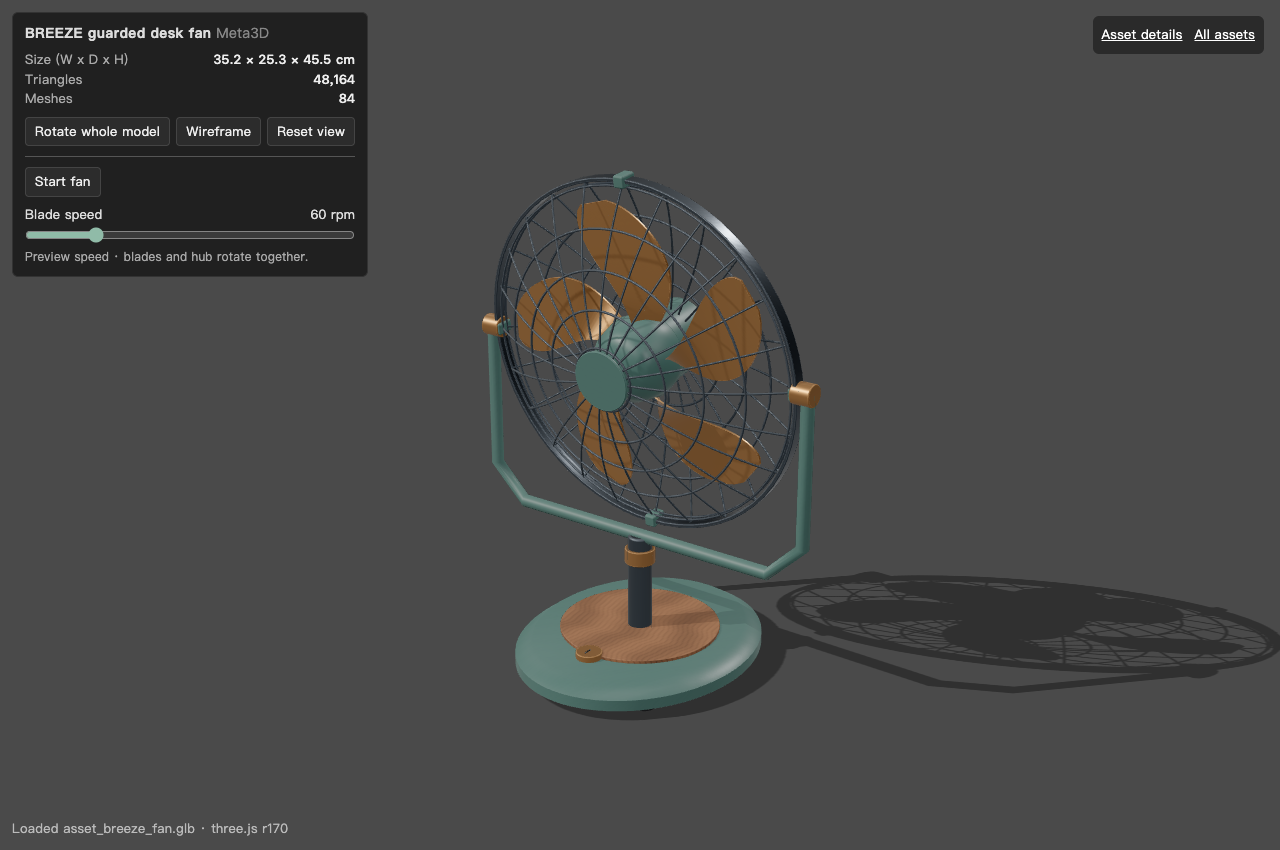
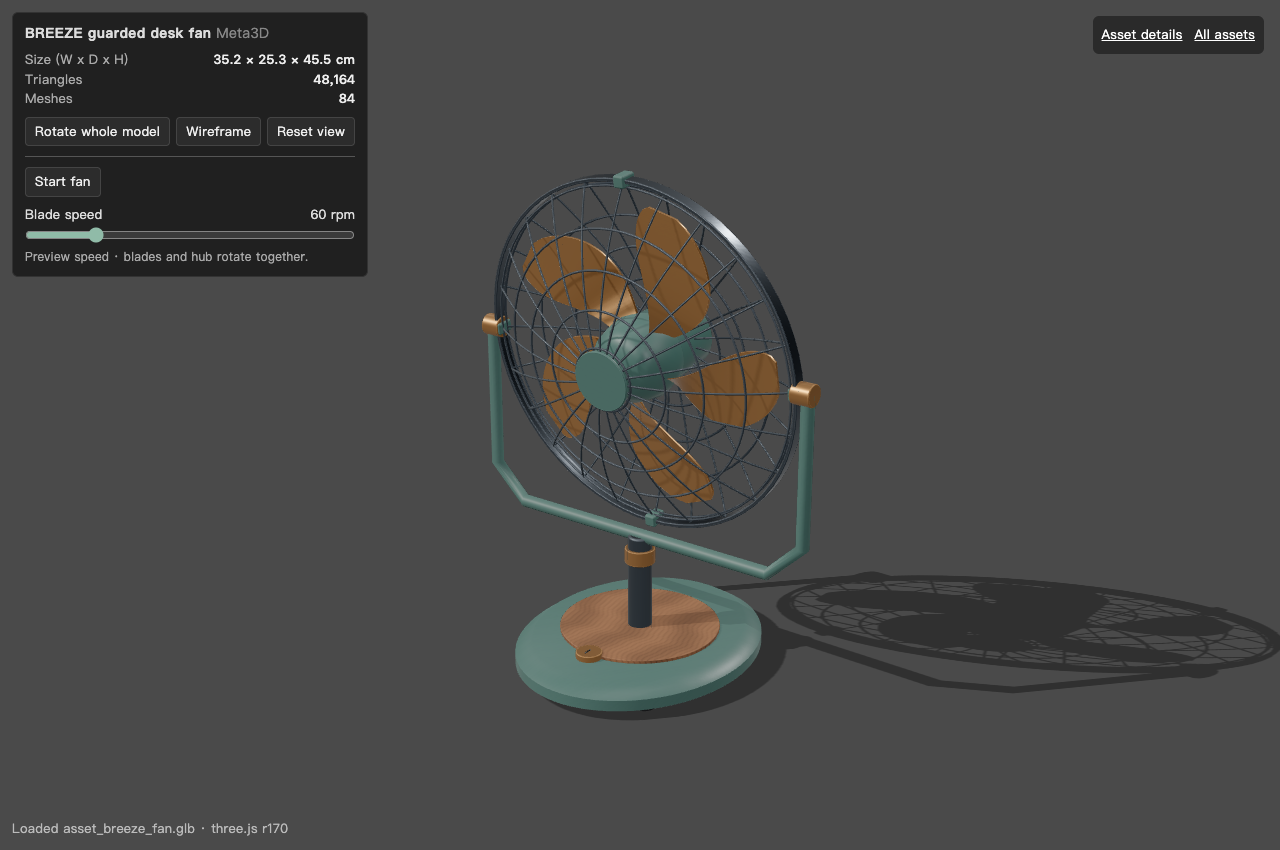
turntable.mp4, 1080p or 1440p, 30 fps, 15 s, one full orbit. The BREEZE fan also has independently controlled blade motion in the live viewer.
Verified on 39 / 39 · complete 15 s rotation
03
Multi-angle renders
renders/: front, back, left, right, top and a hero 45°, plus detail close-ups. Original renders are 2560×2048; BREEZE provides eight 2048×2048 images.
Verified on 39 / 39 · 8 to 13 images each
04
Mesh
mesh/: GLB with textures embedded, and OBJ + MTL referencing the PNG texture sets. Named, separable parts; +Y up, front +Z, 1 unit = 1 metre, origin on the floor.
Verified on 39 / 39 · 3 to 107 meshes · 18 k to 415 k triangles
05
Editable source project
source/blender/*.blend with editable mesh geometry, materials and source scene structure. The original collection uses Blender 4.5 LTS; BREEZE is delivered in Blender 5.2.x with packed textures.
Verified on 16 / 16 · .blend opens, vertices editable · present in the 23 new packages, not yet reopened
06
Parametric procedural build
Asset-specific construction scripts expose adjustable geometry parameters. BREEZE supplies generate_asset.py and parameters.json, including blade count, diameter, stand height and grille density.
Verified on 16 / 16 · e.g. desk width 1.416 → 1.616 m, vase wall 5 → 8 mm rebuilt · build scripts present in the 23 new packages, not yet rerun
01 · SCALE & ORIGIN
Place it and it stands.
The origin sits at the bottom centre, on the floor. Front faces +Z in the GLB. Dimensions in the spec match the mesh to the millimetre, so a desk is 1,416 mm wide and a camera is 175 mm.
02 · PARTS THAT MOVE
Drawers pull. Doors swing. Fan blades spin.
Movable parts are separate named meshes with their pivot at the hinge, pin or slide axis. The spec says which axis and how far; the viewer below lets you operate them.
03 · MATERIALS THAT READ
Crackle, marquetry, chrome.
Each material is a full PBR set painted from the 3D position of every texel, so patterns run continuously across seams. Normal maps carry carving, pores, stitching and glaze crackle; AO is baked in Cycles.
THIRTY-NINE OBJECTS · SIX FAMILIES
Pick a piece. Turn it. Open it.
Live GLB in the browser, the studio turntable, six views and detail renders. Operate the movable parts from the toolbar.
Loading GLB…
LIVE · GLB
Drag to orbit · scroll to zoom · right-drag to pan
Six elements · this package
6 / 6 present
Element
In this package
Status
From the spec sheet · description.txt
Materials · PBR texture sets
Movable / detachable parts
Full spec sheet for this object (description.txt, English section)
Textures & bakePosition-painted PBR · AO in Cycles
→
Studio renderSix views · details · turntable
→
VerifyMesh vs spec · no interpenetration
WORKED SAMPLE · ASSET_BREEZE_FAN · 2026-10-16
From a static fan to an operable preview.
One asset is the data unit. This page now contains 40 distinct assets in six families; the fan is one appliance, not six samples because it has six moving parts. Objects 001–015 come from the earlier A3D collection, BREEZE (016) from the 55-asset Meta3DSamplesFinal English package, and 017–039 from the 2026-10-18 asset delivery (30 packages, of which seven repeat objects already shown here). The 2026-10-19 scene-background sample adds the brass compass (040) and a themed scene — stills and an orbit video — for 017, 019, 020, 029, 032 and 040; its other five objects are byte-identical to the ones already here. This is an asset showcase and delivery audit, not a scored model benchmark.
Request, inputs and starting point
Update brief (editorial summary): make the BREEZE blades rotate and add the fan to this RiderCam page. The starting point is an existing static asset, with five separate blades, a rotor hub and an 8° head tilt. The original asset-generation commission and reference attachments were not supplied here; the original description is a delivered specification, not that missing commission.
Actual output and constraints
The existing GLB and studio media are reused. Browser code adds start/stop and 30–180 rpm preview control. Five blades and the hub rotate; the cage, bracket, stand and base stay fixed. Motion is not baked into GLB, FBX, OBJ or .blend. The 15-second orbit is original delivery media; the before/after QA images below were created for this update.
Acceptance criteria, operations and observed evidence
All six asset criteria are separate required checks. No numerical weights, partial-point formula or benchmark reward were supplied. “6 passed” refers to the prior source-package audit, not a 100% model score. IDs A3D-01…06 are editorial labels. Complete six-item acceptance rules · Original asset audit record and method.
Criterion / requirement
Setup → operation → observation
Result and evidence scope
A3D-01…04 · description, orbit, views, mesh
Inspect the delivered package: 351.8 × 253.44 × 454.794 mm, 84 meshes, 48,164 triangles; eight renders; 2560×1440, 30 fps, 15 s orbit.
Prior audit: pass. Current update also loaded the GLB, played the video and opened the images. Original media evidence.
A3D-05 · editable source
Prior audit opened the supplied .blend in Blender 5.2.1 and inspected editable geometry. A source project and a procedural generator are assessed separately.
Prior audit: pass. Not reopened in this website update. The 8.7 MB .blend remains in the separate source package.
A3D-06 · geometry regeneration
From empty scenes, run the delivered geometry builder twice, changing only blade_count from 5 to 6 in the paired test configurations. Meshes: 84 → 85; triangles: 48,164 → 49,308.
Prior probe: pass, changed geometry observed. Baking, rendering and full export CLI were excluded. Full original probe · Before · After.
VIEW-01 · blade motion (supplemental)
Stop whole-model rotation; start and stop the fan. Compare world matrices: six rotor parts move, 78 other meshes stay fixed; shaft directions and pivots agree within 10⁻⁶. Pause must preserve the pose.
Completed: pass. Standalone runtime evidence. The integrated viewer also passed start/stop image comparison, speed controls, asset switching and original desk controls: integration evidence.
Pass means the stated condition was observed. Partial means some requirements are demonstrated; missing means the required deliverable is absent. Unverified or execution error means the check could not establish a result, not that the product failed. No new Blender generation or physical airflow/collision validation is claimed.
Lengths are metres; tilt is degrees. The generator allows blade_count 3–7, diameter 0.24–0.38 m, stand_height 0.24–0.43 m. Viewer rpm changes pose only and is not a construction parameter. The asset ID joins the catalog record, model and source audit; A3D-06 links to procedural.json. The new browser run is separately identified by integration-verification.json. Missing benchmark weights and scores are null, not zero.
To rebuild, run the command in the linked README from the source package’s source/blender directory with Blender 5.2.x and a separate output directory. The historical geometry-only probe ran successfully; this update did not rerun the full generation/export command. This website requires HTTP and WebGL; files are separate resources, not embedded in a single HTML file. The 39 assets do not claim coverage of all appliance types.
Production, provenance and remaining evidence gaps
Observed update workflow: existing package and audit → identify rotor meshes and axis → implement browser controls → check six moving / 78 stationary meshes → integrate original media → test asset switching, desktop and mobile → publish a versioned preview. This update was implemented by the assistant with automated Chromium checks and screenshot inspection.
Source production method: parameterized Blender construction → UV/material generation → mesh export → studio views and orbit → per-asset audit. This is a description of the supplied pipeline, not evidence that every export stage was rerun here. Original creator identity, expert sign-off, judge calibration and negative-control results were not supplied. No calibrated visual score or expert certification is claimed.
Still missing for a complete model-evaluation task: original commission and reference attachments, public-input/private-evaluator split, model submission and trajectory, calibrated scoring rules and expert review records. These do not erase the observed asset-file and viewer checks. UI access codes are for showcase access; they are not a substitute for isolating private evaluation material.
About this preview and the source packages
Included in this preview
All forty objects. Objects 001–015 and 017–040 use 2K WebP textures for the browser; BREEZE uses its original 9.8 MB GLB with embedded 2K PNG maps. Renders are downsized to 1280–1600 px. Original turntables are 1080p, with BREEZE at 1440p.
Source package per object
Full-resolution GLB and OBJ/MTL, PNG material maps, multi-angle renders, the .blend file and parameterized construction code. Exact files, resolutions and source versions are listed for each selected asset. The BREEZE package includes FBX and an English description.
Conventions
GLB and OBJ are exported +Y up, front facing +Z, scale 1, 1 unit = 1 metre, origin at the bottom centre on the floor. Normal maps use the OpenGL convention. Materials are metal-roughness PBR; clearcoat is used where the spec calls for lacquer or glaze.
Live viewer
three.js r170 with the asset's own GLTFLoader. Lighting is a neutral three-light rig plus a room environment, not the Cycles studio, so tones differ slightly from the renders. Movable parts follow the offsets and rotations defined in each package's threejs preview. BREEZE adds start/stop and speed control for five blades and their hub; that motion runs in the browser and is not baked into the source files.
Rights
Original work. Geometry and textures are generated procedurally by the scripts in each package; no third-party models, textures or scans are used. Free to modify, use commercially and redeliver. three.js is MIT-licensed.
Scale
The same pipeline produces new objects from a written spec: category, structure, materials, dimensions and movable parts. Larger libraries by category, style or era are available on request, with per-object QC against the spec.